Skip to content

Data Security Services

Data security is not a single control. It is a set of deliberate, layered decisions about who can access what, under what conditions, and what happens when something goes wrong.
 
Every organisation holds data that would cause real damage if it were lost, leaked, or misused including customer records, financial information, commercially sensitive documents, regulated data, and employee records. The question is not whether that data needs protecting. The question is whether the protections in place are proportionate, current, and actually working.

Microsolve approaches data security as a practical, managed discipline. We help organisations understand their data exposure, apply appropriate controls, and maintain a security posture that keeps pace with how their business and the threat environment change.

 

Data Security Starts With Knowing What You Are Protecting

A common starting point for organisations that want to improve data security is to ask: what security tools do we need? A better starting point is to ask: what data do we hold, how sensitive is it, and who should have access to it?

Without that foundation, security investment is difficult to direct. Tools are applied broadly rather than where risk is highest. Access controls are set by convenience rather than by need. And the organisation may be spending on controls that protect low-value data while gaps remain in the systems that matter most.

Microsolve helps clients build data security from the ground up starting with visibility, then classification, then controls proportionate to the sensitivity and value of each data type.


How Data Security is Built

Effective data security is layered. No single control is sufficient. The layers work together to reduce the likelihood of an incident, limit the damage if one occurs, and enable the organisation to detect and respond quickly.

Data Discovery and Classification

Before controls can be applied, the data landscape must be understood.

  • What data does the organisation hold?

  • Where does it sit on servers, in Microsoft 365, in cloud applications, on endpoints?

  • How sensitive is it?

  • Who can access it? 

Classification creates the basis for proportionate, targeted controls.

Access Control and Least-Privilege Principles

Users should only have access to the data they need to do their job. Broad, unconstrained access is a significant risk multiplier. It means that a compromised account, a malicious insider, or a social engineering attack has access to far more data than necessary. Microsolve reviews and implements access controls that align with least-privilege principles across on-premise and cloud environments.

Encryption

Sensitive data should be encrypted both in transit as it moves between systems and users, as well as at rest where it is stored on servers, endpoints, and cloud platforms. Encryption does not prevent all attacks, but it significantly limits the value of data to an attacker who obtains it without the keys to read it.

Monitoring and Anomaly Detection

Access to sensitive data should be logged and monitored. Unusual patterns — a user accessing a large volume of files outside working hours, a new connection from an unfamiliar location, attempts to access restricted areas — are indicators worth investigating. Monitoring turns security from a one-time configuration task into an ongoing, active discipline.

Endpoint Data Controls

Data does not only sit on servers. It moves to endpoints - laptops, workstations, mobile devices - where it may be stored, transmitted, or shared outside managed channels. Endpoint controls ensure that sensitive data is handled appropriately as it moves through the organisation.

Vulnerability Management

Security vulnerabilities in operating systems, applications, and services create pathways for attackers to access data. Regular patching, vulnerability scanning, and configuration hardening reduce the attack surface and prevent common exploitation techniques.


When Data Carries Specific Obligations

Not all data security needs are equal. Organisations that hold personal information, health records, financial data, or information subject to specific regulatory frameworks carry obligations that go beyond general good practice.

In Australia, the Privacy Act 1988 and the Australian Privacy Principles set out requirements for how personal information must be handled, stored, and protected. The Notifiable Data Breaches scheme requires organisations to notify the Office of the Australian Information Commissioner and affected individuals when a breach is likely to result in serious harm.

Beyond privacy legislation, frameworks including the ASD Essential Eight, ISO 27001, and industry-specific requirements define standards that many organisations are expected to meet or align with.

Microsolve works with clients to understand their specific obligations and design data security controls that are proportionate, documented, and defensible, not just technically adequate.


Managed Data Security Services

Microsolve delivers data security as a managed, ongoing service, not a one-off assessment or a product sale. Our approach covers the full lifecycle of data security from initial assessment through to implementation, monitoring, and regular review.

What we provide:

Data Security Assessment

Reviews current data landscape, access controls, permissions, and exposure against risk profile.

Data Classification Support

Defines sensitivity categories and maps existing data accordingly.

Access Control Review and Implementation

Designs least-privilege access across on-premise and cloud environments including Microsoft 365 and Azure AD / Entra ID.

Encryption Implementation

Deploys at-rest and in-transit encryption for sensitive data across servers, endpoints, and cloud storage.

Microsoft 365 Data Security

Configures Data Loss Prevention (DLP) policies, sensitivity labels, information barriers, and external sharing controls.

Monitoring and Alerting

Provides continuous monitoring of data access, sharing activity, and security events with alerting for anomalies.

Patch and Vulnerability Management

Delivers regular patching and vulnerability scanning to maintain hardened infrastructure.

Security Posture Reviews

Conducts periodic reviews of data security environment against current threats and evolving business requirements.

Incident Support

Offers expert support for data security incidents, including containment, recovery, and breach notification guidance.


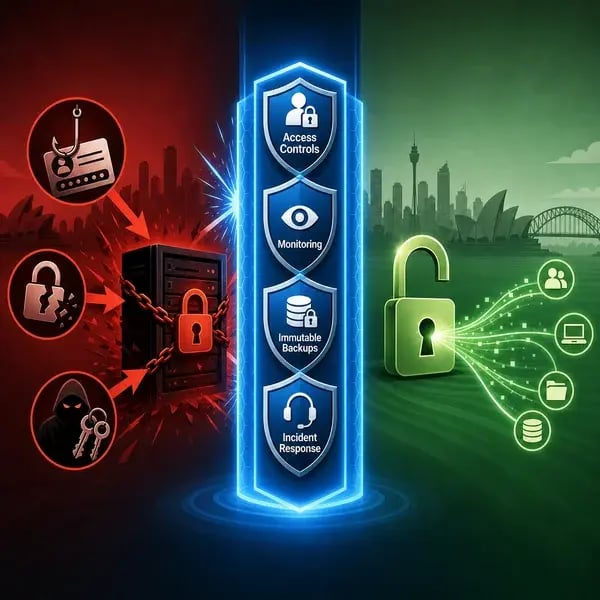
Ransomware is Fundamentally a Data Security Problem

Keep data secure to protect yourself against ransomware

Ransomware does not create vulnerabilities, it exploits them. The most common pathways are credential compromise, phishing, and unpatched systems. Once inside, ransomware seeks out the data that matters most to the organisation and makes it inaccessible unless a ransom is paid.

Preventing ransomware and recovering from it both depend on strong data security practices: access controls that limit how far an attack can spread, monitoring that detects unusual activity early, immutable backups that provide a clean recovery path, and incident response plans that are tested before they are needed.

Data security and backup are not separate disciplines. They are complementary layers of the same operational resilience posture.

Learn more about Backup and Data Recovery

Frequently asked questions

What is meant by data security?

Data security refers to the combination of controls such as technical, administrative, and policy-based, that protect business data from unauthorised access, modification, loss, or exposure. It includes access controls, encryption, monitoring, patch management, and incident response.

Where should a business start with data security?

Start with visibility. Understand what data you hold, where it sits, how sensitive it is, and who can access it. That assessment gives the basis for proportionate, targeted controls rather than applying tools broadly and hoping for the best.

What are the main risks to business data?

The most common sources of data loss and exposure are ransomware and malware, phishing and credential compromise, insider threat (accidental or malicious), misconfigured cloud services, and lost or unprotected endpoint devices.

What is the Privacy Act and how does it affect data security?

The Privacy Act 1988 and the Australian Privacy Principles require organisations that handle personal information to protect it from misuse, loss, and unauthorised access. The Notifiable Data Breaches scheme requires organisations to notify affected individuals and the OAIC when a breach is likely to cause serious harm. Appropriate data security controls are integral to meeting these obligations.

What is least-privilege access?

Least-privilege access means users are only granted access to the data and systems they need to perform their role and nothing more. Limiting access reduces the potential damage from compromised accounts, malicious insiders, or social engineering attacks.

How does Microsoft 365 fit into data security?

Microsoft 365 contains a significant volume of sensitive business data — email, documents, contacts, communications. Proper data security in a Microsoft 365 environment includes DLP policies, sensitivity labels, access controls, audit logging, and external sharing restrictions. Microsolve manages these configurations as part of a broader data security service.

Understand your data exposure before something else does

A data security assessment gives you a clear, practical view of where your organisation's data sits, who can access it, and where the meaningful risks are. It is the starting point for proportionate, manageable protection.