

Skip to content

Email Retention Obligations for Aged Care Providers Under Australian Law

The Aged Care Act 2024 ends "audit prep crunches". The Aged Care Quality and Safety Commission (ACQSC) can request evidence at anytime, requiring tamper-proof electronic records including emails. The Privacy Act and Quality Standards mandate 7 years retention post-service for resident care, complaints, and incidents. Systems must block premature deletions while enabling secure disposal.

Microsolve turns these rules into automated reality, protecting providers from gaps or over-retention risks.


Key Retention Requirements

Aged care providers face three core retention requirements that form the foundation of compliance under the new Aged Care Act 2024, Privacy Act 1988, and strengthened Quality Standards. These aren't just boxes that need to be ticked off. They're in place to protect residents, defend against complaints or investigations, and shield your organisation from penalties.

Microsolve's immutable email archiving turns these obligations into automated safeguards, capturing every message pre-inbox for tamper-proof retention in Australian AWS regions.

7+ Years for Core Records

Emails documenting resident care plans, incidents, complaints, or family communications must be retained for at least 7 years after the last service entry under Privacy Act requirements and Aged Care Rules. This ensures complete evidentiary chains for audits or disputes, preventing gaps that could question care quality or response times.

Microsolve's immutable archiving automatically applies these exact periods, eliminating manual tagging or guesswork while providing full-text search for rapid retrieval.
Perpetual Audit Access

The ACQSC now demands instant access to records at any time, not just during scheduled audits, making "perpetual readiness" the new standard under the Aged Care Act 2024. Without immediate, searchable evidence, providers risk enforcement actions, fines, or loss of registration during unannounced reviews or investigations.

Our solution stores emails immutably with timestamped metadata, enabling keyword, date-range, or sender-based searches in seconds, so you're always audit-ready without sifting through deleted or scattered inboxes.

Privacy & Standards Compliance Card

Quality Standards and the Privacy Act mandate secure handling of personal health information, including Australian data sovereignty to avoid cross-border risks, with systems preventing unauthorised access or premature deletion. Breaches here trigger investigations or resident complaints, eroding family trust and operational continuity.

Microsolve hosts everything locally in AWS regions with role-based access, encryption, and audit trails that automatically block deletions while enabling compliant disposal post-retention.


Setting Retention Policies in Microsoft 365 and Email Archiving

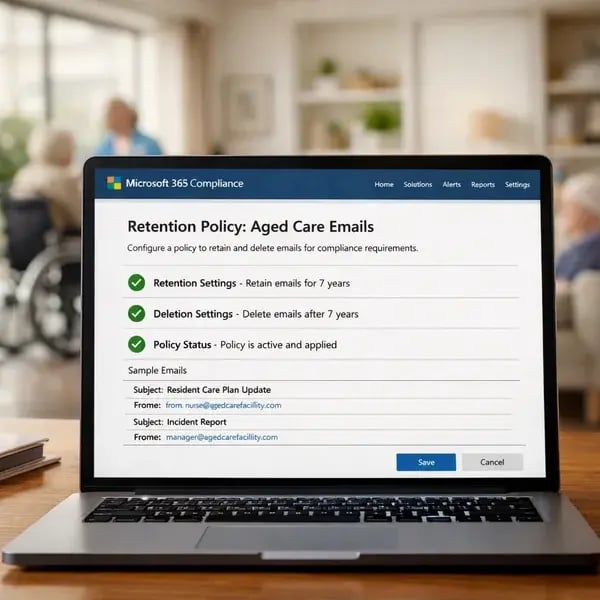
aged care microsoft 365 compliance with 7-year retention laws with immutable email archiving

Microsolve tailors Microsoft 365 retention labels and policies specifically to aged care requirements, such as 7-year holds for incident-related emails and automatic disposal with full audit trails once retention periods end. Our immutable email archiving solution captures all inbound and outbound emails before they reach inboxes, automatically de-duplicates messages, and applies encryption for secure eDiscovery access. This integrates seamlessly with Outlook and Exchange Online, ensuring multi-site aged care providers maintain continuous compliance without disrupting daily operations.

Explore Immutable Email Archiving

Avoiding Common Mistakes

Even with good intentions, aged care providers often stumble on email retention pitfalls that expose them to ACQSC audits, Australian Information Commission investigations, or unnecessary costs. These mistakes turn compliance from a strength into a liability, but they're easily avoided with the right approach.

Problem

Many providers hoard emails indefinitely, causing storage bloat and Privacy Act risks from excess personal data exposure.

Others delete too early, creating gaps during sudden audits that trigger fines or enforcement actions.

Solution

Microsolve sets precise Microsoft 365 retention policies tailored to aged care rules like 7-year holds for incidents with automatic disposal and audit trails.

We pair this with immutable pre-inbox archiving to eliminate user-dependent failures from staff turnover, delivering strategic compliance without added complexity.

Email Archiving Problems

Meeting Audit requirements with Email data management

Unexpected quality audits are a fact of life for Aged Care facilities. Rapid access to email evidence, irrespective of who's inbox it was sent to is a challenge and may be the only way to answer an audit question. Imagine if you could query every email across every Inbox for that missing artefact in less than 20 seconds.

Protecting Email in High Staff-turnover roles

Staff turnover is disruptive in any care situation. The potential for loss of email data during such an event is high, but can be managed.

Protecting Resdient and Family Correspondance

Email is a critical information exchange tool between residents, their families and care staff - managing accountability takes planning

Incident reports and complaint Investigation

Rapid access for investigators requiring complete communication trails to verify care quality and response actions

Frequently asked questions

Does email retention apply to personal staff inboxes or just shared ones?

Personal staff inboxes are a major blind spot as owners, families, and clinicians often email individual carers directly, creating compliance gaps when staff delete or leave. Microsolve's immutable archiving captures all inbound email regardless of destination, with role-based access so successors see only relevant history without Privacy Act over-exposure.

What counts as a 'clinical email' needing 7-year retention vs routine admin?

The line blurs easily. Emails mentioning resident names, care preferences, or incident details qualify as health records under Privacy Act APPs, even if it's brief. We train teams on sensitivity labels ("Clinical-7Y" vs "Admin-3Y") in Microsoft 365, auto-applying retention while flagging borderline cases for review to prevent both over-retention bloat and accidental deletions.

If a resident passes away, does their email history need indefinite retention?

No. Retention clocks start from last service (typically 7 years), however, complaints or coronial inquiries can extend this indefinitely. Our hybrid setup combines Microsoft 365 event-based retention (triggered by resident status changes) with immutable archives holding high-risk threads forever, ensuring defensible access without hoarding everything.

How do you prove retention compliance during a surprise ACQSC audit?

Auditors demand live evidence: retention policy screenshots, audit logs showing no deletions, and sample searches retrieving family correspondence instantly. Microsolve provides quarterly compliance dashboards plus one-click export reports proving chain-of-custody, turning audits from stress into routine demonstrations of your robust setup.

Can staff still use email normally with retention policies active?

Yes! Policies run silently in the background; staff delete freely without breaking compliance since immutable copies persist. We customise deletion warnings only for labelled sensitive emails, plus quick-search shortcuts in Outlook, so care teams focus on residents while staying fully audit-ready.

What about emails with attachments like care plans or incident photos?

Attachments inherit the email's retention but risk separate expiry in OneDrive/SharePoint. Microsolve links them via Microsoft 365 retention labels, ensuring family-shared PDFs or GP referrals stay bundled and searchable as complete records—critical for serious incident investigations where context matters.

Start your Immutable Email Archiving Journey

Protect your residents and your reputation by being compliant and audit ready with email archiving with Microsolve. Start now with an obligation-free assessment.