



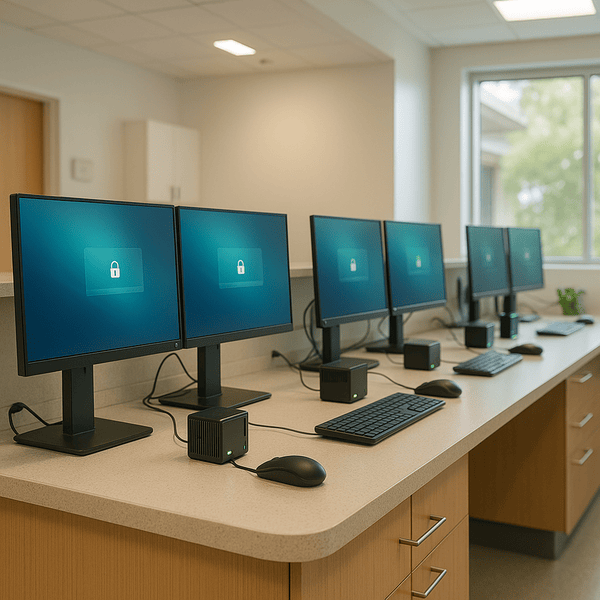
How IGEL-powered thin clients cut energy use and risk for aged care.
Why thin clients are a good fit for aged care
Aged care providers are under constant pressure to strengthen cyber security, control operating costs, and meet sustainability expectations, while keeping clinicians and care staff productive. Modern thin client endpoints, connected to secure virtual desktops or cloud applications, give staff fast access to the systems they need without storing sensitive data on each device.
This architecture keeps data and processing in the data centre or cloud, and turns each device into a secure window focused on display, peripherals, and sign‑in only. For multi‑site facilities and rotating or agency staff, a standardised thin client build means a nurse can sign in at any workstation, get the same secure apps, and start work within minutes.

Security, compliance, and continuity
Thin clients with a hardened, read‑only operating system reduce cyber risk by shrinking the attack surface and making it harder for malware to persist. If a device is lost or stolen, there is far less resident or staff data on it, which reduces the impact, investigation effort, and the likelihood of a notifiable data breach.
Centralised patching and application control support Australian Cyber Security Centre (ACSC) Essential Eight guidance around application hardening, patching, and restricting administrative privileges. For organisations handling personal and clinical information, keeping data off endpoints and in controlled environments also supports obligations under the Australian Privacy Principles.
Sustainability and energy savings
Thin clients can play a practical role in sustainability and ESG programs by cutting energy use and extending device life. Repurposing suitable existing PCs as software‑defined thin clients reduces e‑waste and embodied carbon from premature hardware replacement.
When hardware is refreshed, fanless thin client devices typically draw significantly less power than general‑purpose desktops, especially at nurse stations and shared work areas that run for long hours. Independent analysis and vendor case studies report double‑digit percentage reductions in endpoint energy use when organisations move to thin client models and reuse devices where possible.
Operational simplicity for lean IT teams
For lean internal IT teams and distributed facilities, thin clients can simplify day‑to‑day support. Central image management, policy‑based lockdown, and native support for major virtual desktop platforms reduce the need for on‑site visits and complex local builds.
Standardised, stateless endpoints help new hires and temporary staff get working quickly: sign in, deliver the right apps, and go. With remote monitoring, automated updates, and a minimal OS that avoids background updaters and consumer apps, organisations often see fewer endpoint incidents and lower total cost of ownership.
Quantifying the ROI: energy, security, lifecycle
When evaluating a thin client business case in aged care, three levers usually dominate: energy, security, and lifecycle economics. Power draw is the easiest to measure, with many modern thin clients using far less energy at the wall than traditional small form factor PCs during typical use.
Software‑defined thin clients can also reduce lifecycle energy and emissions because they support device reuse and delay the need for full hardware replacement. At the same time, moving data and applications into the data centre or cloud reduces local attack surface, simplifies patching, and makes recovery from compromise or failure faster and more predictable.
With a thin client approach, capable existing PCs can be converted into locked‑down endpoints instead of being replaced, deferring capital spend and reducing e‑waste. Where new endpoints are required—for example, at high‑resolution clinical workstations—fanless thin clients are typically more durable, quieter, and easier to support in multi‑site environments.
Planning a smooth migration with central management
A successful transition to thin clients starts with a clear view of your current environment. Inventory existing endpoints, peripherals, and critical applications, then group them by usage profile such as nurse stations, clinical documentation, medication management, allied health, and administration.
For each group, confirm that required workflows perform well on your chosen virtual desktop or published application platform, including any device integrations such as scanners, label printers, and card readers. Design a standard endpoint image with a secure, minimal operating system configured for read‑only operation, device control, and modern authentication, and integrate this with your identity provider so multi‑factor authentication is enforced for privileged and remote access.
Rolling out at scale is far easier when every endpoint is managed centrally. Central policy control lets you tune power management, browser hardening, USB restrictions, and display settings by role, and schedule updates within maintenance windows that minimise disruption to care teams.
Pilot in one facility with a representative mix of users, gather feedback, and refine performance settings and peripheral mappings before wider rollout. Establish gold images for each user group and an automated build process for zero‑touch onboarding, while keeping a documented path back to a full desktop for rare, exceptional use cases.
Finally, measure outcomes over time. Track energy use at sample locations, incident rates per 100 endpoints, time to provision new workstations, and user satisfaction, and feed these into your ESG and service continuity reporting.

Where a partner like Microsolve fits
For organisations that cannot afford downtime or a data breach, a security‑first thin client environment works best when it is designed, monitored, and supported end‑to‑end by a trusted partner. Microsolve helps aged care providers design and manage secure thin client estates so staff have reliable access to the systems they need, while IT, cyber security, and compliance stay quietly under control in the background.
Many providers do not have the time or in‑house skills to plan and run this transition across multiple facilities. Microsolve’s team can map your current endpoints, design a hardened standard build aligned with Australian guidance, and manage the rollout with minimal disruption to staff and residents.
We took the same staged, one-site-first approach when transforming WiFi for a multi-site aged care provider.