
IT Support for Accountants and Accounting Firms
Microsolve provides managed IT, cyber security and email archiving for Australian accounting firms, tax agents and BAS agents. We secure client tax file numbers and financial records, set up the controls the Tax Practitioners Board expects, and keep your systems running when lodgement deadlines cannot move.
We have supported Australian businesses since 1992 from our base in Wollongong, with teams serving Sydney, the Illawarra, the Central Coast, Newcastle and Canberra. Microsolve holds SMB1001:2026 Gold certification, so we follow the same cyber controls we recommend to your practice.

Why accounting firms are a target for cyber criminals
An accounting practice holds tax file numbers, bank details, payroll data and access to the ATO on behalf of every client. That makes one compromised login valuable to a criminal. The ATO has warned of fraudulent activity targeting tax professionals' systems, where malicious links install malware so third parties can obtain client information and potentially interact with the ATO through Online services for agents.
Email is the other weak point. Invoices, payment instructions and tax refunds travel by email, so a hijacked mailbox or a lookalike domain can redirect money from your clients as easily as from your own accounts.
Professional obligations that shape an accounting firm's IT
TPB confidentiality and record keeping
Under the Code of Professional Conduct, registered tax practitioners must not disclose client information to a third party without permission unless there is a legal duty to do so. Since 1 July 2025, practices with 100 or fewer employees have also had to meet the Tax Agent Services (Code of Professional Conduct) Determination 2024. That includes keeping client records for at least five years after the service is provided and having quality management systems in place.
The TPB expects adequate policies, systems and controls to protect the security and confidentiality of client records, with records stored so they cannot be changed or damaged. Cloud and outsourced services are allowed, but you must consider confidentiality and where the data is sent and stored.
ATO online services and data breaches
The ATO's terms for Online services for agents require you to keep client data from unauthorised people, monitor how staff use the service and make sure staff know your data breach response plan. If a breach happens, the ATO asks tax professionals to call its Client Identity Support Centre on 1800 467 033 so it can protect affected client accounts, alongside your obligations under the Notifiable Data Breaches scheme. The ATO also recommends multi-factor authentication on all devices used for your business.
AML/CTF obligations started on 1 July 2026
From 1 July 2026, AML/CTF obligations apply to designated services that accountants and trust and company service providers commonly provide, such as company and trust structuring and handling client money. Firms that provide them must enrol with AUSTRAC, typically by 29 July 2026, carry out customer due diligence and keep most records for seven years. Those firms are also covered by the Privacy Act for that information, regardless of turnover.
IT problems we fix for accounting firms
-
Shared or weak logins to client and ATO portals. We enforce MFA and individual accounts across Microsoft 365, practice software and portals, and remove access the day someone leaves.
-
Client documents emailed back and forth. Secure portals and controlled SharePoint sharing replace attachments carrying TFNs and bank statements.
-
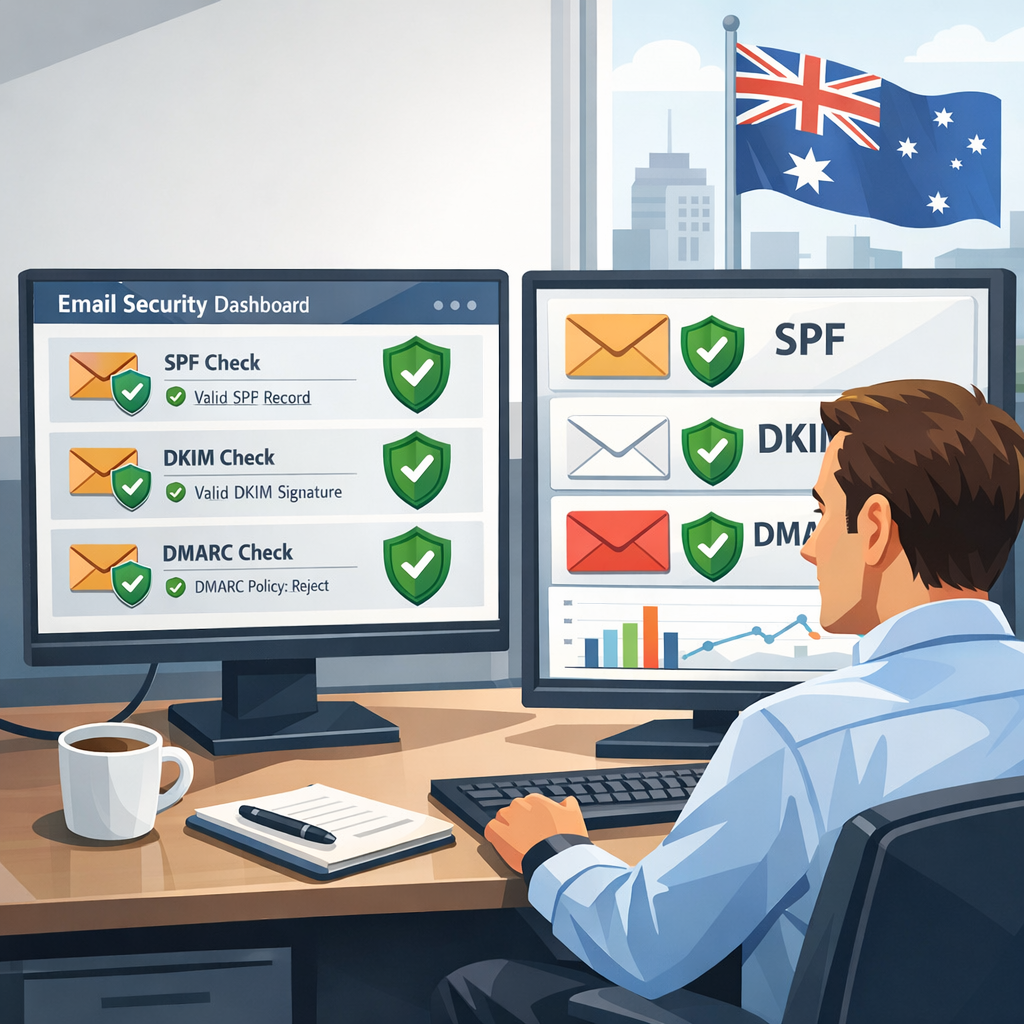
Invoice and refund redirection. SPF, DKIM and DMARC on your domain and external sender tagging make spoofed emails easy to spot.
check your domain -
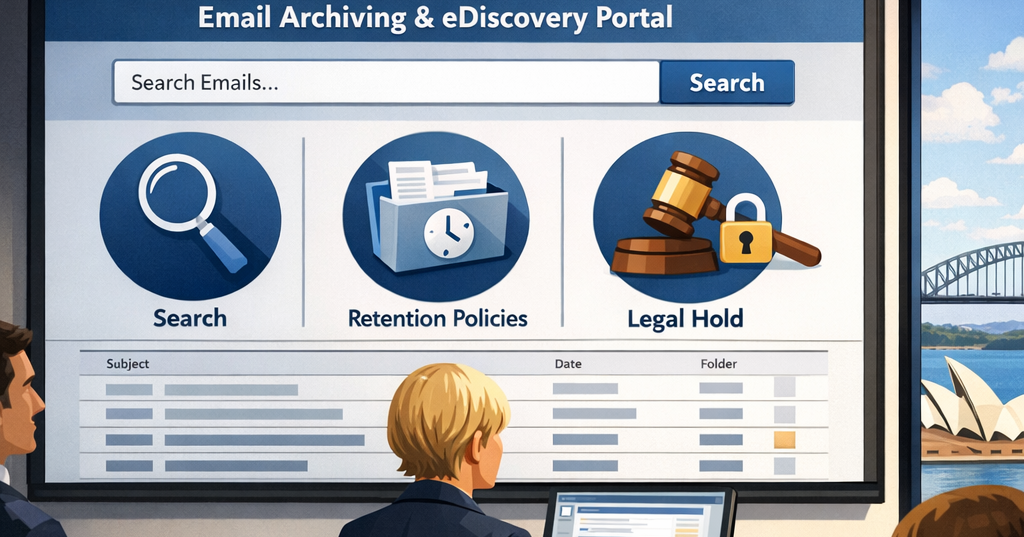
Records you cannot prove are unaltered. An immutable archive keeps every email for the TPB's five-year minimum and beyond.
-
Tax-time slowdowns. We schedule upgrades and changes outside your peak lodgement periods and monitor systems so problems are fixed before staff notice.
-
Old servers running desktop accounting software. We move them to Australian AWS regions or a managed cloud setup so the office is no longer a single point of failure.
Recommended IT bundle for accounting firms
Most law firms need managed IT support, a hardened Microsoft 365 tenant and an immutable email archive as the core, with SMB1001 certification and a vCIO to keep security and spending on track. AWS hosting is added when you still run practice software on a local server.
| Service | Priority | What it covers | Why law firms need it |
|---|---|---|---|
| Managed IT support | Core | Service desk, device management, patching, monitoring and vendor coordination | Keeps staff productive through lodgement peaks |
| Microsoft 365 security and modern workplace |
Core | MFA, conditional access, SharePoint and Teams by matter, and data loss prevention | Protects TFNs and client financial data |
| Email authentication and reputation |
Core | SPF, DKIM and DMARC enforcement and monitoring | Stops invoice and refund redirection using your domain |
| Immutable email archive | Core | Tamper-proof archive, fast search, retention | Keeps records unaltered for the TPB five-year minimum and beyond |
| Backup and recovery | Core | Tested backups of servers, Microsoft 365 and practice data | Recovering from ransomware without missing deadlines |
| SMB1001 certification | Recommended | A staged program through Bronze and Silver to Gold | Shows clients and insurers that the "adequate controls" the TPB expects are in place |
| vCIO | Recommended | Technology roadmap, budget, risk register and partner reporting | Plans software changes and spending around the tax calendar |
| AWS hosting | Situational | Hosting desktop accounting or practice software in Australian AWS regions | When the office server is ageing or staff work remotely |
| IT procurement (mProcure) | Situational | Sourcing devices and licences | Growth, new staff and tax-season contractors |
Pricing depends on your headcount and current setup. Our vCIO Starter plan begins at $1,143 per month for three months on a single stream, and our guide to outsourced IT support costs explains what drives the rest.

Further reading for accounting firms

Accounting firm IT: frequently asked questions
What IT support does an accounting firm need?
Most accounting firms need managed IT support, MFA on every account and device, a secured Microsoft 365 tenant, DMARC on their domain, tested backups and an immutable email archive. A recognised cyber standard such as SMB1001 helps show clients and insurers that controls are in place. See our recommended IT bundle for accounting firms.
What does the Tax Practitioners Board expect for data security?
The TPB expects registered tax practitioners to have adequate procedures, policies, systems and controls to protect the security and confidentiality of client records, and to store records so they cannot be changed or damaged. Its record keeping guidance specifically mentions cloud computing, cyber attacks and outsourcing as reasons this matters.
How long do we need to keep client records?
At least five years after the tax agent service is provided, under section 30 of the Code Determination. Records covered by AML/CTF obligations generally need to be kept for seven years, so many firms set seven years as their default. An immutable email archive keeps email unaltered for whichever period applies.
What should we do if our practice has a data breach?
Call the ATO's Client Identity Support Centre on 1800 467 033 so it can protect affected client accounts, assess your obligations under the Notifiable Data Breaches scheme, tell affected clients and contact your software provider, as set out in the ATO's data breach guidance for tax professionals. Then reset credentials, remove unneeded access and find the cause before reconnecting systems.
Do the AML/CTF reforms apply to accountants?
They apply to accountants who provide designated services. Since 1 July 2026, those firms have had to enrol with AUSTRAC, run an AML/CTF program, carry out customer due diligence and keep records, according to AUSTRAC. Check with your professional body or adviser which of your services are designated.
Can we store client data in the cloud?
Yes. The TPB does not prohibit cloud storage or outsourcing, but you must consider confidentiality, including where data is sent and stored, according to its confidentiality guidance. We set up Microsoft 365 and AWS so client data stays in Australian regions with access limited to the people who need it.
How much does IT support for an accounting firm cost?
It depends on headcount, sites and how much is already in place. Our guide to outsourced IT support costs explains the main cost drivers.
A cyber risk review is the quickest way to get a firm quote.
Talk to us about your practice's IT
Book a cyber risk review with Dale Jenkins. We will check your logins, email security and record retention against what the TPB and ATO expect, and tell you what to fix first.